


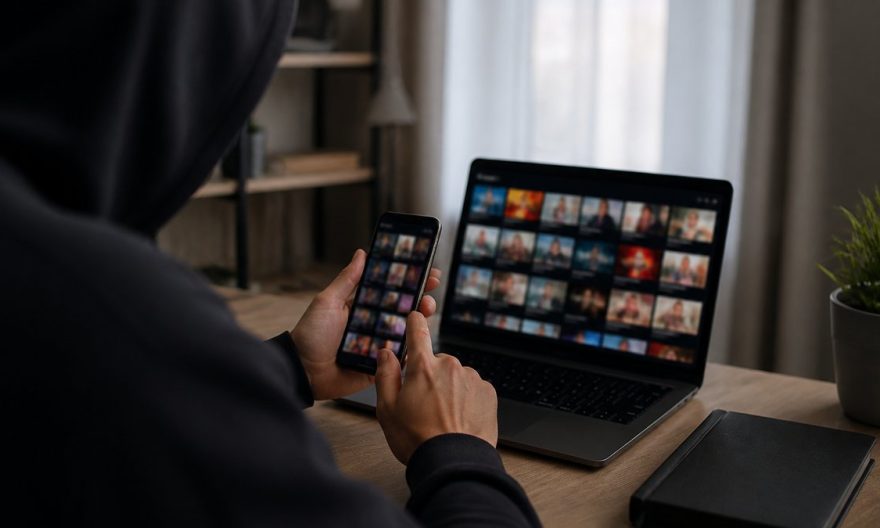
Imagine for a moment: you are comfortably settled at home, eager to discover the latest episode of your favorite series, when you come across a tempting advertisement promising free access to television channels. Curious, you click, download the app, and unknowingly open the door of your smartphone to strangers. This scenario, which might seem like something out of a movie, became a reality for many users in 2026.
An app promising free streaming, named StreamRat by experts, has caused trouble among Android smartphone users. Discovered by the security company ThreatFabric, it allowed cybercriminals to access millions of devices, turning them into real open doors to your privacy. Let’s examine how this threat managed to infiltrate our digital daily lives.
The 3 key facts
- A fake app named StreamRat targets Android users to steal personal information.
- Cybercriminals use social media ads to promote this deceptive app.
- Once installed, the app allows remote control of the infected device.
Threat on Android with StreamRat
Since June 2026, a suspicious app has circulated under the names StrεαmTV Pro and Sistema, luring users with the promise of free content. However, it turned out to be a real Trojan horse, allowing cybercriminals to take control of the Android phones it infects.
Un vide-dressing occasionnel rapporte rarement plus de 200 € par mois. Mais l'écart avec les vendeurs les plus performants est plus large qu'on ne le pense : 300 à 900 €/mois pour une activité régulière (2 à 5h/semaine), et 1 000 à 2 500 €+/mois pour les profils qui traitent Vinted comme un vrai canal de vente structuré. La différence ne tient ni à la chance ni à la taille du dressing de départ : elle tient presque entièrement à la méthode (algorithme, pricing, réactivité) appliquée avec régularité.
Avec 📘 Le Guide Vinted, transformez ce canal en revenu complémentaire structuré, voire en une vraie activité e-commerce.
Une méthode complète pour décoder l'algorithme, optimiser vos annonces comme une landing page, automatiser votre relance commerciale et sécuriser votre activité sur le plan fiscal.
🧠 Les 5 facteurs qui pilotent la visibilité de vos annonces (logique proche du SEO)
📈 Une méthode réplicable pour passer d'une activité occasionnelle à un revenu récurrent
⚖️ Statut, fiscalité, professionnalisation : rester en règle en montant en volume
🚫 Le chapitre que personne n'aborde ailleurs : comprendre et prévenir les blocages de compte
Victims, attracted by ads on platforms such as Facebook, Instagram, and TikTok, downloaded this malicious app, thinking they were accessing free television channels. Unfortunately, by agreeing to make the app their default home screen and activating an unnecessary VPN, they paved the way for deep infiltration.
Manipulation and control techniques
Once installed, StreamRat exploits Android’s accessibility service. This feature, initially designed to help people with disabilities, is hijacked to read screen content, record keystrokes, and overlay fake screens on banking apps. This allows hackers to steal sensitive information, such as banking credentials.
Infected users see their phone transformed into a device under foreign control, with hackers able to remotely access the device via a hidden system called HVNC. This technological evolution of cybercrime highlights the ingenuity and persistence of cybercriminals.
Spread and impact of fraudulent ads
The impact of StreamRat was particularly felt in Spain, where the app was mainly distributed. However, its influence quickly spread, affecting Spanish-speaking, French-speaking, Portuguese-speaking, and Chinese-speaking users through targeted advertising campaigns on Meta.
In parallel, other fraudulent apps, like Brokewell, have emerged, intercepting SMS verification codes and targeting cryptocurrency wallets. Cybercriminals continue to invent new strategies to reach an ever-wider audience.
Frequently asked questions about streaming app threats
How to recognize a fraudulent streaming app?
Fraudulent apps often present themselves with enticing promises, such as free access to premium content. Always check user reviews, the origin of the app, and avoid downloading apps outside of official platforms.
What to do if I think I downloaded a malicious app?
It is crucial to uninstall the app immediately and run a full scan with reliable antivirus software. Change your passwords and monitor any suspicious activity on your accounts.
Why do malicious apps mainly target Android?
Android, due to its popularity and flexibility, is often the preferred target of cybercriminals. The ability to install apps from third-party sources makes users more vulnerable to attacks.
How to protect against these threats?
It is essential to keep your operating system up to date, use reliable security software, and be cautious of offers that seem too good to be true. Avoid installing apps from unverified sources.
Mobile security in 2026: challenges and innovations
In 2026, mobile security remains a major issue for users and developers. Technological advances, such as artificial intelligence, play a crucial role in detecting and preventing threats. Companies are investing in more robust systems to protect users’ sensitive data.
Users, for their part, are encouraged to adopt good digital practices, such as two-factor authentication and the use of password managers, to strengthen their online security.
The future of cybersecurity: trends to watch
By 2030, cybersecurity is expected to focus more on automation and machine learning to anticipate threats. Companies like Palo Alto Networks and FireEye are developing cutting-edge technologies to counter increasingly sophisticated attacks.
At the same time, international collaboration is becoming essential to combat cybercrime. Initiatives like the UN Cybersecurity Forum allow countries to share information and coordinate their efforts to protect users globally.