


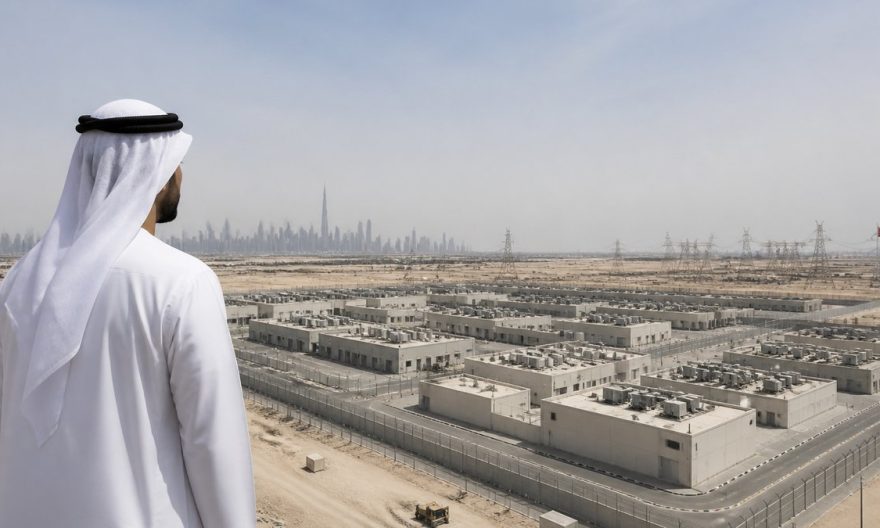
The ambitious plans of the United Arab Emirates for their mega data center, initially designed to be a technology campus in the desert, are being disrupted by the threat of Iranian strikes. Security concerns are forcing the authorities to completely rethink their deployment strategy, transforming this project into a network of dispersed sites. These changes could have major implications for the future of artificial intelligence infrastructure in the region.
The key points to remember
- The UAE-US AI Campus project was initially intended to be a 26-square-kilometer campus near Abu Dhabi.
- Iranian threats have forced the Emirates to rethink their strategy, dispersing the data centers to avoid targeted attacks.
- This new configuration could affect technical performance and increase the costs of the Stargate project.
Imagine a desert transformed into a nerve center of advanced technology, where every grain of sand could hold a secret of artificial intelligence. You are in the United Arab Emirates, where ambitions to become a global leader in AI are facing unprecedented security challenges. How does a high-tech campus project transform into a network of underground complexes? Let’s discover together the behind-the-scenes of this transformation.
The initial ambitions of the UAE-US AI Campus project
The UAE-US AI campus, orchestrated by G42 and led by Sheikh Tahnoun bin Zayed al Nahyan, was to become a symbol of the technological power of the Emirates. In partnership with giants such as NVIDIA, Oracle, Cisco, and SoftBank, this colossal project aimed to provide immense computing power to OpenAI. The first phase, valued at $30 billion, was ready to offer 1 gigawatt of computing power, with an initial capacity of 200 megawatts planned for this year.
Un vide-dressing occasionnel rapporte rarement plus de 200 € par mois. Mais l'écart avec les vendeurs les plus performants est plus large qu'on ne le pense : 300 à 900 €/mois pour une activité régulière (2 à 5h/semaine), et 1 000 à 2 500 €+/mois pour les profils qui traitent Vinted comme un vrai canal de vente structuré. La différence ne tient ni à la chance ni à la taille du dressing de départ : elle tient presque entièrement à la méthode (algorithme, pricing, réactivité) appliquée avec régularité.
Avec 📘 Le Guide Vinted, transformez ce canal en revenu complémentaire structuré, voire en une vraie activité e-commerce.
Une méthode complète pour décoder l'algorithme, optimiser vos annonces comme une landing page, automatiser votre relance commerciale et sécuriser votre activité sur le plan fiscal.
🧠 Les 5 facteurs qui pilotent la visibilité de vos annonces (logique proche du SEO)
📈 Une méthode réplicable pour passer d'une activité occasionnelle à un revenu récurrent
⚖️ Statut, fiscalité, professionnalisation : rester en règle en montant en volume
🚫 Le chapitre que personne n'aborde ailleurs : comprendre et prévenir les blocages de compte
This project represents not only a technological advancement but also a geopolitical ambition of the Emirates to establish themselves on the global stage of artificial intelligence. However, the landscape has radically changed after recent events.
The new threats and the response of the Emirates
In March, tensions escalated with Iranian attacks on several Gulf countries. The Emirates, having already suffered damage to two AWS data centers, decided to rethink their protection strategy. An Iranian video explicitly threatening the data center precipitated this decision.
Rather than building a single campus, the Emirates are now opting for a network of dispersed data centers. Some of these sites will be buried, and critical data will potentially be hidden in the mountains. Anti-aircraft defenses and reinforced infrastructures will also be put in place to ensure the security of these facilities.
The technical and financial implications of the new plan
The dispersion of data centers is not without consequences. The performance of AI models could suffer because the physical proximity of chips is crucial for calculation efficiency. This reorganization could also delay the project and increase costs, a hard blow for the Stargate project, already facing delays in the UK due to energy constraints.
These adjustments raise questions about the viability of the Emirates’ strategy for AI expansion, as technical and security challenges multiply.
The energy challenges of the Stargate project in the UK
In parallel, the Stargate project is encountering difficulties in the UK. The temporary suspension of the project there is due to energy supply issues, a major obstacle in deploying such energy-intensive infrastructures. This context highlights the broader challenges faced by global mega data center projects.
The implications for the global data center industry
The situation of the United Arab Emirates and the Stargate project illustrates a broader issue in the data center sector. As computing power needs increase, companies must navigate between security constraints and energy challenges. Among others, players like Amazon Web Services and Microsoft Azure are closely monitoring these developments to adapt their strategies.
The quest for sustainable solutions in terms of energy and security is becoming a central theme for the future of the data center industry. How companies manage these challenges will influence their ability to grow and innovate in an increasingly complex global environment.
FAQ
What is the UAE-US AI Campus project?
It is an ambitious mega data center project initially planned to be built as a 26-square-kilometer campus near Abu Dhabi, aimed at providing immense computing capacity to OpenAI.
Why did the United Arab Emirates change their initial plan?
Due to the threats of Iranian strikes, the Emirates decided to disperse their data centers to reduce the risks of targeted attacks and enhance the security of their facilities.
What are the technical challenges posed by the dispersion of data centers?
The dispersion of facilities can affect the performance of AI models due to the need for physical proximity of chips, extend commissioning times, and increase the overall costs of the project.
What are the broader implications for the data center industry?
The security and energy challenges faced by the Stargate project reflect the global issues the data center industry must address, influencing the strategies of major players such as AWS and Microsoft Azure.