


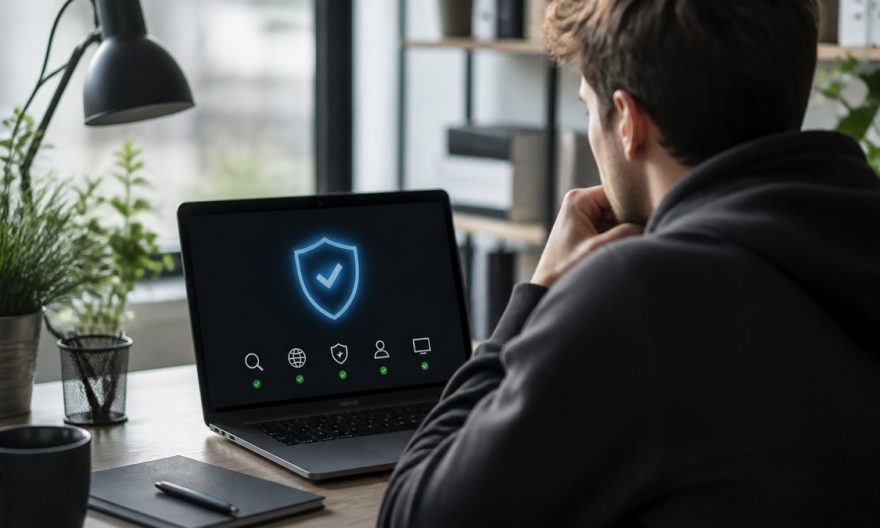
As we move rapidly into the second half of the decade, the question of the necessity of antivirus arises with renewed urgency. Cyberattacks continue to multiply, despite technological advances. In 2026, is digital security up to the threats, or does antivirus remain an indispensable tool to protect our devices?
Key Takeaways
- Antiviruses have evolved to include advanced features such as behavioral detection and artificial intelligence.
- The built-in security of operating systems has significantly improved but does not completely replace a dedicated antivirus.
- Cyber threats are increasingly sophisticated, requiring constant vigilance and robust security solutions.
Imagine yourself, comfortably settled at home, surfing the Internet without worry. You download an attachment from a seemingly harmless email. Yet, within seconds, your screen fills with error messages and your files lock up. This scene might seem like something out of a movie, but it is a reality for many people who fall victim to cyberattacks every day. How can you prevent this from happening to you? Is antivirus the answer?
Advancements in Antivirus: Artificial Intelligence and Behavioral Detection
In 2026, antivirus software no longer just detects known virus signatures. Thanks to the integration of artificial intelligence and behavioral detection, they now analyze suspicious activities in real-time. These technologies allow for the recognition of new attack patterns, thus offering proactive protection against emerging threats. For example, a modern antivirus can identify a malicious file simply by observing its suspicious behavior, without needing a prior signature.
Un vide-dressing occasionnel rapporte rarement plus de 200 € par mois. Mais l'écart avec les vendeurs les plus performants est plus large qu'on ne le pense : 300 à 900 €/mois pour une activité régulière (2 à 5h/semaine), et 1 000 à 2 500 €+/mois pour les profils qui traitent Vinted comme un vrai canal de vente structuré. La différence ne tient ni à la chance ni à la taille du dressing de départ : elle tient presque entièrement à la méthode (algorithme, pricing, réactivité) appliquée avec régularité.
Avec 📘 Le Guide Vinted, transformez ce canal en revenu complémentaire structuré, voire en une vraie activité e-commerce.
Une méthode complète pour décoder l'algorithme, optimiser vos annonces comme une landing page, automatiser votre relance commerciale et sécuriser votre activité sur le plan fiscal.
🧠 Les 5 facteurs qui pilotent la visibilité de vos annonces (logique proche du SEO)
📈 Une méthode réplicable pour passer d'une activité occasionnelle à un revenu récurrent
⚖️ Statut, fiscalité, professionnalisation : rester en règle en montant en volume
🚫 Le chapitre que personne n'aborde ailleurs : comprendre et prévenir les blocages de compte
Artificial intelligence also enables continuous adaptation. Systems learn from new threats and adjust their responses accordingly, thus reducing the time between the discovery of a threat and its neutralization. This learning capability is crucial in an ever-evolving cybersecurity landscape.
Built-in Security of Operating Systems in 2026
Modern operating systems, such as Windows 11 and macOS Monterey, have significantly improved their built-in security. They now include advanced security tools, like firewalls, ransomware protections, and intrusion detection systems. These native protections offer a first line of defense that may suffice for the average user.
However, despite these improvements, operating systems cannot always provide complete protection against all threats. Targeted attacks, for example, can bypass these built-in defenses. In this context, a dedicated antivirus offers a valuable additional layer of security, capable of blocking more sophisticated attacks.
Cyber Threats in 2026: More Sophisticated Than Ever
Cyber threats have evolved alongside technologies. In 2026, cybercriminals use increasingly sophisticated techniques such as “zero-day” attacks and targeted phishing. These threats require advanced security solutions and increased vigilance from users. “Zero-day” attacks exploit unknown vulnerabilities in software, making systems particularly vulnerable before patches are released.
Moreover, targeted phishing, or spear phishing, uses personal information to create personalized attacks that are difficult to detect. These threats require security tools capable of recognizing anomalies and blocking scam attempts before they reach the end user.
Towards Integrated Digital Security: The Era of Unified Platforms
While antivirus remains a crucial element of cybersecurity, a new trend is emerging: unified security platforms. These integrated solutions combine antivirus, firewall, network monitoring, and data protection into a single suite. They offer simplified management and centralized control, thus reducing potential security gaps. These platforms are particularly popular with companies looking to protect their complex infrastructures against a wide range of threats.
FAQ
Is an antivirus still necessary if I use a modern operating system?
Although modern operating systems have improved their built-in security measures, a dedicated antivirus offers additional protection against advanced and targeted threats.
Is artificial intelligence in antivirus reliable?
Yes, artificial intelligence significantly improves real-time threat detection and adapts to new attacks, thus increasing the reliability of antivirus software.
Are unified security platforms suitable for individuals?
While primarily used by businesses, individuals can also benefit from unified security platforms, especially if they handle sensitive data or use multiple connected devices.
How do antiviruses detect unknown threats?
Modern antiviruses use advanced techniques such as behavioral detection and machine learning to identify and neutralize unknown threats before they cause damage.