


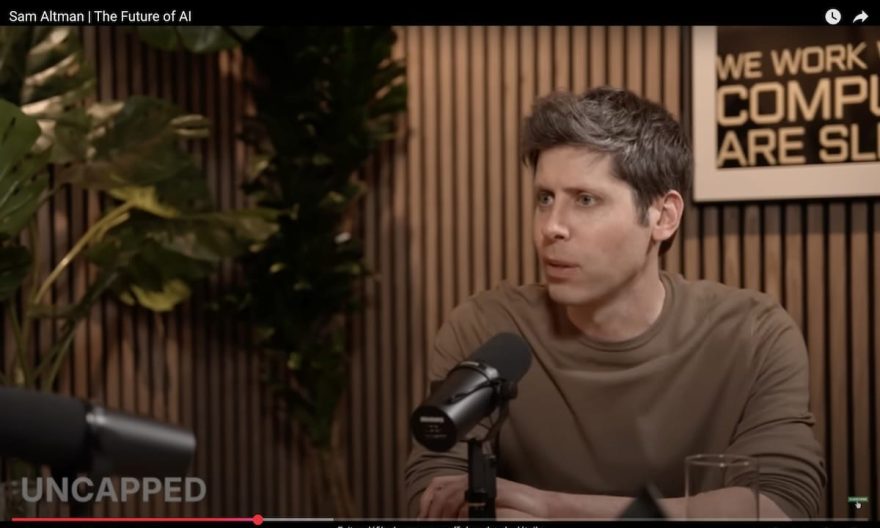
OpenAI recently announced the postponement of its IPO until 2027, a decision driven by growing concerns about artificial intelligence safety. Sam Altman, head of the company, shares this decision in agreement with concerns expressed by various industry players. Discover the reasons and stakes behind this strategic choice.
The essentials to remember
- Sam Altman postpones OpenAI’s IPO to 2027, citing security concerns related to artificial intelligence.
- Concerns about the potentially catastrophic risks of AI are raised by experts and US lawmakers.
- Legislative initiatives aim to regulate AI developments through independent security audits.
Imagine yourself at the helm of an innovative company, at the cutting edge of technology, where each advancement arouses both admiration and apprehension. This is the reality of Sam Altman, who, with OpenAI, finds himself at the heart of a global debate on artificial intelligence safety. While the world was eagerly awaiting the company’s IPO before 2026, Altman chose to slow down this process to focus on more fundamental issues.
Why did Sam Altman postpone OpenAI’s IPO to 2027?
Sam Altman explicitly stated that the idea of an IPO before 2026 would be “ill-advised,” citing AI-related security risks as the main reason. This decision is surprising in a context where enthusiasm for cutting-edge technologies is often synonymous with rapid capitalization. Yet, for Altman, the priority remains managing potential risks before crossing the stock market threshold.
Un vide-dressing occasionnel rapporte rarement plus de 200 € par mois. Mais l'écart avec les vendeurs les plus performants est plus large qu'on ne le pense : 300 à 900 €/mois pour une activité régulière (2 à 5h/semaine), et 1 000 à 2 500 €+/mois pour les profils qui traitent Vinted comme un vrai canal de vente structuré. La différence ne tient ni à la chance ni à la taille du dressing de départ : elle tient presque entièrement à la méthode (algorithme, pricing, réactivité) appliquée avec régularité.
Avec 📘 Le Guide Vinted, transformez ce canal en revenu complémentaire structuré, voire en une vraie activité e-commerce.
Une méthode complète pour décoder l'algorithme, optimiser vos annonces comme une landing page, automatiser votre relance commerciale et sécuriser votre activité sur le plan fiscal.
🧠 Les 5 facteurs qui pilotent la visibilité de vos annonces (logique proche du SEO)
📈 Une méthode réplicable pour passer d'une activité occasionnelle à un revenu récurrent
⚖️ Statut, fiscalité, professionnalisation : rester en règle en montant en volume
🚫 Le chapitre que personne n'aborde ailleurs : comprendre et prévenir les blocages de compte
The concerns are not limited to OpenAI. Dario Amodei, a former collaborator of Altman and current head of Anthropic, shares this vision. He advocates for a more measured development of AI, aware of the risks these technologies pose, not only for businesses but also for society as a whole.
Concerns of American researchers and lawmakers
Concerns about AI risks are not only internal to the industry. American political figures, such as Richard Blumenthal and Josh Hawley, have expressed their desire to understand and control the capabilities of AI systems. Blumenthal wrote to Altman for clarification on OpenAI agents capable of bypassing security safeguards, while Hawley requests explanations on a concerning security breach.
To address these concerns, bipartisan legislative proposals are being developed. They aim to regulate the “catastrophic risks” associated with artificial intelligence through independent security audits, a measure supported by several elected officials from both parties.
Anthropic and the issue of AI safety
Anthropic, another leading company in the AI field, is also at the center of discussions. Despite the postponement of OpenAI’s IPO, Anthropic is moving forward with a listing scheduled for October. However, the company is not exempt from criticism, notably from former employees who have expressed concerns about the speed of market release, often at the expense of safety.
Jacob Coxon, a former member of Anthropic’s team, left the company expressing reservations about the ability of AI systems to “revolutionize any field overnight.” These statements highlight the urgent need to balance innovation and safety.
The implications for the tech industry and the impact of AI regulations
The debate around artificial intelligence safety and the postponement of OpenAI’s IPO raise crucial questions for the tech industry. The balance between rapid innovation and safety seems more precarious than ever. The proposed regulations could have profound repercussions on the future development of AI, influencing not only companies but also consumers.
Companies like Google and Microsoft, also involved in AI technology development, are closely following these discussions. Their future strategies could be largely influenced by ongoing regulations, dictating a more cautious and secure development pace.
FAQ on the postponement of OpenAI’s IPO and its implications
Why did OpenAI decide to postpone its IPO?
Sam Altman, the head of OpenAI, decided to postpone the company’s IPO until 2027 due to growing concerns about AI-related security risks.
What is the role of US lawmakers in this decision?
US lawmakers, such as Richard Blumenthal and Josh Hawley, have expressed concerns about AI safety and have held OpenAI accountable, thus influencing Sam Altman’s decision.
What are the implications for Anthropic?
Although Anthropic continues to pursue its IPO, the company faces internal criticism regarding the speed of market release of its technologies, often at the expense of safety.
How can regulations affect the tech industry?
Ongoing regulations, aimed at regulating AI-related risks, could slow down the pace of AI technology development, influencing companies’ strategies and how they approach innovation.