


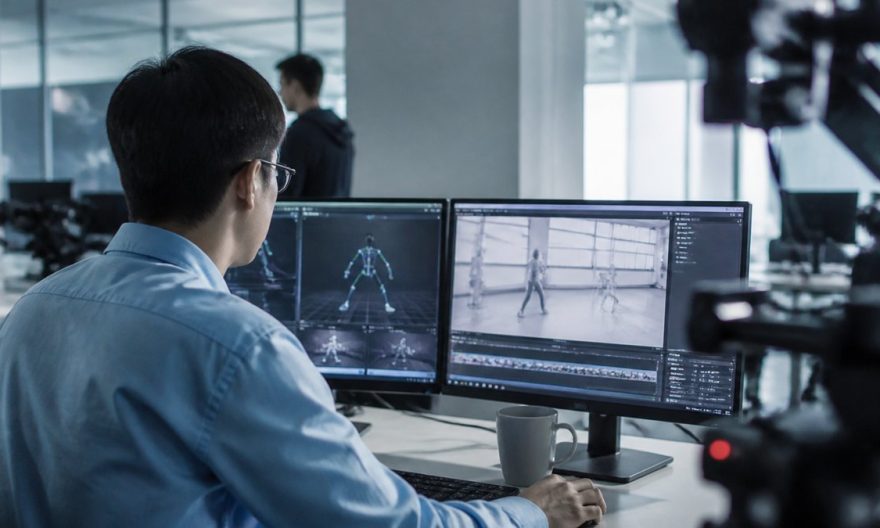
In a world where artificial intelligence continues to push boundaries, ByteDance stands out for its ambition to revolutionize the way we interact with spatial videos. Under the leadership of its founder, Zhang Yiming, the Chinese company is set to launch a promising AI model that could transform virtual reality experiences.
The essentials to remember
- ByteDance is developing an AI model to generate spatial videos in real-time.
- The project relies on Seedance and could be launched as early as next month.
- The videos would be generated in the cloud, thus reducing hardware requirements for VR headsets.
Imagine being immersed in a virtual environment, where every movement and word finds an immediate echo. This is what ByteDance plans to achieve with its advanced AI model. By leveraging its expertise in video, the company aims to create interactive virtual worlds that could transform live broadcasts and video games.
ByteDance and the AI model under the supervision of Zhang Yiming
ByteDance, known for its technological advancements, is actively working on an artificial intelligence model that promises to redefine the creation of spatial videos. This ambitious project is led by Zhang Yiming, the founder of the company. The goal is to generate videos in real-time, allowing for the creation of dynamic and interactive virtual worlds.
Un vide-dressing occasionnel rapporte rarement plus de 200 € par mois. Mais l'écart avec les vendeurs les plus performants est plus large qu'on ne le pense : 300 à 900 €/mois pour une activité régulière (2 à 5h/semaine), et 1 000 à 2 500 €+/mois pour les profils qui traitent Vinted comme un vrai canal de vente structuré. La différence ne tient ni à la chance ni à la taille du dressing de départ : elle tient presque entièrement à la méthode (algorithme, pricing, réactivité) appliquée avec régularité.
Avec 📘 Le Guide Vinted, transformez ce canal en revenu complémentaire structuré, voire en une vraie activité e-commerce.
Une méthode complète pour décoder l'algorithme, optimiser vos annonces comme une landing page, automatiser votre relance commerciale et sécuriser votre activité sur le plan fiscal.
🧠 Les 5 facteurs qui pilotent la visibilité de vos annonces (logique proche du SEO)
📈 Une méthode réplicable pour passer d'une activité occasionnelle à un revenu récurrent
⚖️ Statut, fiscalité, professionnalisation : rester en règle en montant en volume
🚫 Le chapitre que personne n'aborde ailleurs : comprendre et prévenir les blocages de compte
The model in question relies on Seedance, the video generation system already in place at ByteDance. According to Bloomberg, the AI could produce videos at a rate of 20 frames per second with a latency of only 50 milliseconds, an achievement made possible through cloud processing.
Technical specifications and impact on the cloud
The decision to perform processing in the cloud is strategic. It aims to reduce the hardware constraints of virtual reality headsets, making the technology more accessible. Users could enjoy responsive environments without needing expensive and high-performance hardware.
This model could be particularly useful for live broadcasts, short films, and video games, offering unprecedented immersive and interactive experiences. The technology could also find applications in 3D simulation for entertainment and gaming, two rapidly growing sectors.
ByteDance’s strategic priorities for 2026
At the beginning of the year, ByteDance identified four key priorities for its AI developments by 2026. “World models” top the list, supported by a significant data budget. These models aim to generate coherent spaces capable of reacting to user actions, an ambitious project that could position ByteDance as a leader in the sector.
Compared to Google’s Genie, ByteDance’s goal is to deliver a model capable of navigating complex and dynamic environments. The world models would benefit from funding three to four times higher than that of its competitors, highlighting the company’s commitment to innovation.
World models: a promising future for virtual reality
“World models” represent a major advancement in creating coherent virtual environments. These systems learn to understand and reproduce the behavior of environments, making them more interactive and immersive. ByteDance, with its rich video data heritage, is ideally positioned to lead this revolution.
The ability to generate realistic and responsive virtual worlds could transform entire sectors, from education to the entertainment industry. By combining video data with advanced algorithms, ByteDance hopes to offer unprecedented experiences to its users.
Challenges and opportunities in the virtual reality industry
Virtual reality is evolving rapidly, and companies like ByteDance play a crucial role in its development. However, challenges remain, particularly in terms of latency, resolution, and accessibility. Giants like Meta are also working on similar technologies, intensifying the competition.
The potential applications of virtual reality are vast, from immersive education to medicine, entertainment, and commerce. To thrive, companies must not only master the technology but also understand the needs and expectations of users. Partnerships with key industry players may be necessary to overcome these challenges and fully exploit the potential of this technology.
FAQ on ByteDance’s AI model for spatial video
What is ByteDance’s AI model for spatial video?
It is a system developed by ByteDance to generate spatial videos in real-time, enabling immersive and interactive virtual reality experiences.
How does cloud processing improve the user experience?
By moving processing to the cloud, ByteDance reduces hardware requirements for VR headsets, allowing users to access advanced experiences without investing in expensive hardware.
What are the main application areas of this technology?
The main applications include live broadcasts, short films, video games, and 3D simulations for entertainment and education.
How does ByteDance compare to other companies in the sector?
ByteDance stands out for its substantial data budget and video expertise, giving it a competitive advantage over other companies developing similar technologies.