


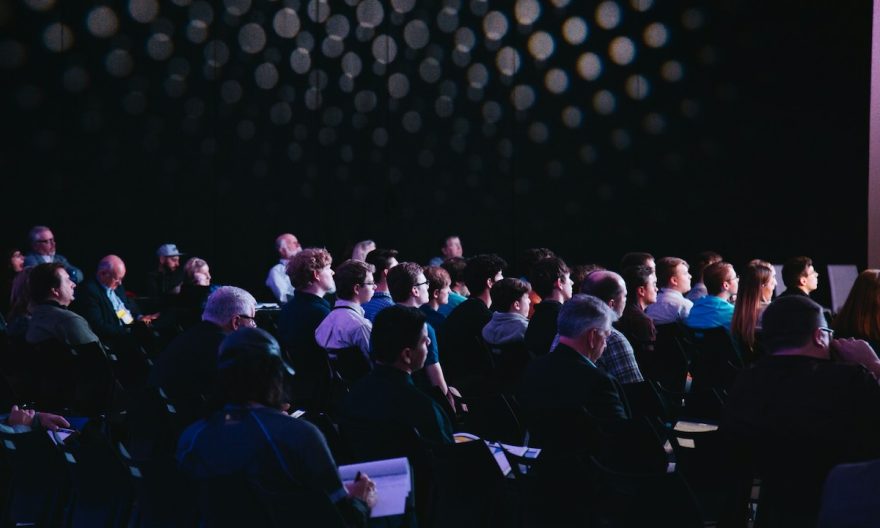
An Olympic athlete who takes the stage sometimes convinces a board of directors more than a sponsored campaign on Instagram. French companies are increasingly relying on recognized figures, former champions, leaders, and industry experts to deliver their message directly to an audience of decision-makers. This shift is explained by a change in standards: credibility now takes precedence over reach, as traditional indicators of influence lose relevance. The phenomenon affects sectors far removed from professional sports, from logistics to construction, whenever a company seeks to embody a message rather than just broadcast it. Speakers, long confined to internal events, are thus emerging as a new brand channel.
Celebrities, experts, and athletes, a lever of credibility for companies
A successful public speaking engagement relies on a precise choice: the personality must embody a value that the company wants to associate with its name, not just attract attention. In this field, an agency dedicated to speakers like StartnPlay has positioned itself as an intermediary between brands and a network of athletes, experts, and personalities available for live interventions. Rather than relying on social networks like a traditional influencer agency, it organizes conferences, round tables, and public relations operations where the speech is delivered to a real audience. Companies like RATP or Eiffage have trusted StartnPlay for this type of intervention, proving that the format goes far beyond the sports world. This positioning reflects a growing demand from B2B companies for interventions capable of enriching both an internal event and an external public relations operation. The agency complements its offer with hybrid formats, celebrity marketing, or product placement, aimed at companies seeking an endorsement of expertise rather than just digital exposure.
Why does trust shift the focus away from social networks?
Un vide-dressing occasionnel rapporte rarement plus de 200 € par mois. Mais l'écart avec les vendeurs les plus performants est plus large qu'on ne le pense : 300 à 900 €/mois pour une activité régulière (2 à 5h/semaine), et 1 000 à 2 500 €+/mois pour les profils qui traitent Vinted comme un vrai canal de vente structuré. La différence ne tient ni à la chance ni à la taille du dressing de départ : elle tient presque entièrement à la méthode (algorithme, pricing, réactivité) appliquée avec régularité.
Avec 📘 Le Guide Vinted, transformez ce canal en revenu complémentaire structuré, voire en une vraie activité e-commerce.
Une méthode complète pour décoder l'algorithme, optimiser vos annonces comme une landing page, automatiser votre relance commerciale et sécuriser votre activité sur le plan fiscal.
🧠 Les 5 facteurs qui pilotent la visibilité de vos annonces (logique proche du SEO)
📈 Une méthode réplicable pour passer d'une activité occasionnelle à un revenu récurrent
⚖️ Statut, fiscalité, professionnalisation : rester en règle en montant en volume
🚫 Le chapitre que personne n'aborde ailleurs : comprendre et prévenir les blocages de compte
Since 2025, influencer marketing has been going through a phase of maturity: according to an analysis published by the agency TEAM LEWIS in December 2025, the race for followers gives way to the search for meaning, and credibility becomes the central indicator of campaigns. A speaker listened to by a few hundred decision-makers in a room often weighs more than a post seen by millions of passive accounts. This logic explains the rise of live interventions, where the audience is qualified, captive, and already engaged with the subject matter. It also aligns with an underlying trend in the sector: budgets dedicated to influence are increasing and are now part of 360-degree communication strategies rather than just one-off operations. Sector studies, like the white paper published by Stellar Tech at the end of 2025, also highlight the rise of corporate ambassadors alongside traditional content creators.
What this format changes for brands that want to engage
Engaging in this field requires moving away from a traditional sponsorship logic: it’s not about renting an image for a 24-hour story, but about building an intervention consistent with the company’s communication strategy. The choice of profile is as important as the chosen format, whether it’s a conference, a round table, or a public relations operation associated with an event. However, there is a risk: a poorly chosen personality, without a real connection to the sector, produces the opposite effect and undermines the sought-after credibility. A clear brief on the message to be conveyed, shared in advance with the speaker, significantly reduces this risk. Well-calibrated, the operation establishes a lasting association between the brand and the values carried by the speaker, a benefit that few traditional advertising formats manage to reproduce.
A channel that adds to the digital strategy, without replacing it
No brand is giving up its social accounts. Most operations built around a speaker extend their digital reach afterward: filmed excerpts, quotes reused internally, content shared on LinkedIn in the weeks following the event. The format then serves as raw material for a broader campaign, anchored in reality rather than content designed solely for the algorithm. For a B2B company seeking sectoral notoriety, this complementarity often weighs more than the choice of the speaker itself.
Influencer marketing has not disappeared in favor of a simple return to traditional public relations. It has rather been recomposed, adding to the digital arsenal of brands an embodied speech, measurable in ways other than views or likes. The phenomenon is only in its early stages in France, far from the scale it already knows in Anglo-Saxon countries. Companies investing in this field today are betting on credibility built over time, rather than ephemeral visibility. It remains to choose the right face to deliver the right message to the right audience.